

Manchester boasts a rich and captivating history of Jewish immigrants. During periods of persecution and repression, many Jews found a new home in Manchester, contributing significantly to the city’s cultural and economic development. Among the prominent Jewish figures who left an indelible mark on Manchester is Michael Marks, the co-founder of the renowned company Marks & Spencer. His life story is a testament to how the ambition, determination, and vision of immigrants can not only build a business empire but also shape a city. From a humble immigrant to a distinguished entrepreneur, Michael Marks overcame numerous challenges to establish one of the most iconic retail brands in the United Kingdom. And it all began in Manchester. Next on manchesterski.com.
Early Life of Michael Marks
Michael Marks was born in 1859 in Slonim, a city that was then part of the Russian Empire (modern-day Belarus). He was raised in an Ashkenazi Jewish family. Like many Jews in Eastern Europe during that time, the Marks family faced religious persecution, limited economic opportunities, and political instability. Jews were often pressured to convert, marry into Orthodox Christian families, or face severe restrictions on living and working in the Russian Empire. These hardships sparked a wave of Jewish emigration to the United States, Europe, and the United Kingdom in the 19th century.
The UK, particularly Manchester, was an attractive destination due to its status as the first industrial city, offering job opportunities in factories and mills. In 1882, at the age of 23, Michael Marks left his homeland in search of safety and opportunities, settling in Leeds, a city near Manchester.
The Growth of Michael Marks’ Business
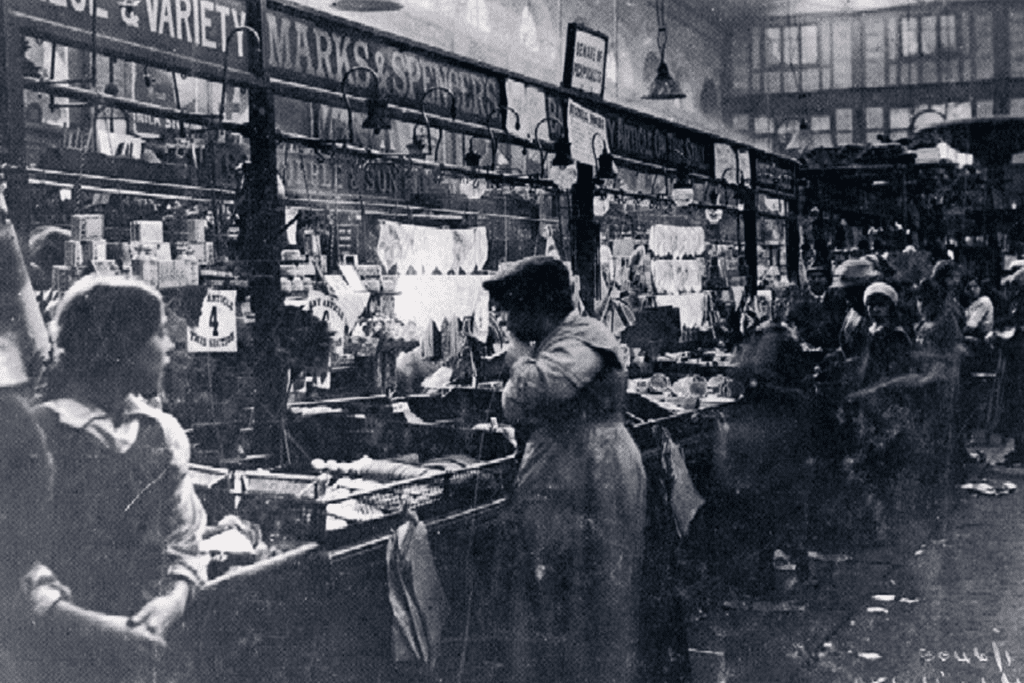
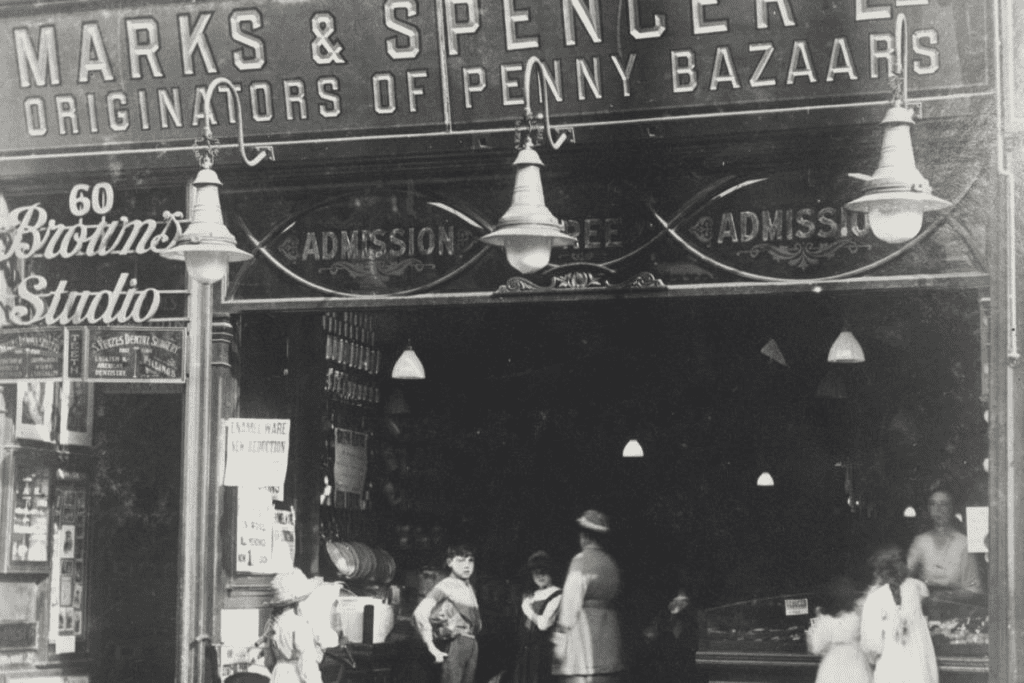
After two years in Leeds, Marks met Isaac Dewhirst, a warehouse owner. Marks struck a deal with Dewhirst to purchase goods for resale in neighbouring villages. This venture proved successful, allowing Marks to save enough money to open a stall at the Leeds market. Using the slogan “Don’t ask the price—it’s a penny,” he sold goods at markets in Castleford and Wakefield. Eventually, he rented a space at a new covered market in Leeds, operating six days a week. Over the following years, he expanded his trade, opening similar stalls in covered market halls across Yorkshire and Lancashire.
The Birth of Marks & Spencer
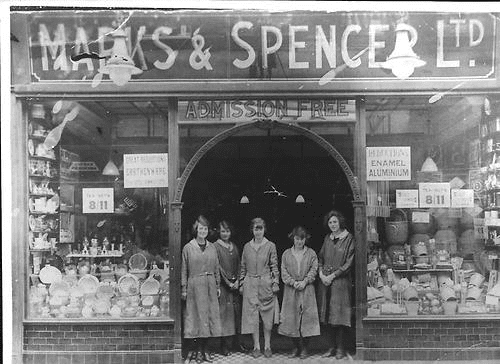
In 1894, Marks sought to significantly expand his business and needed a partner. He approached his former collaborator, Isaac Dewhirst, who declined but recommended his cashier, Thomas Spencer. Spencer saw potential in the venture and decided to invest £300 (approximately £40,766 in today’s money) in exchange for a stake in the business.
The partnership divided responsibilities: Spencer managed the office and warehouse, while Marks focused on running the market stalls. Spencer also leveraged his connections with Dewhirst to establish direct relationships with manufacturers, securing better prices for goods. This collaboration allowed the business to open stores in cities such as Manchester, Birmingham, Liverpool, Middlesbrough, Sheffield, Bristol, Hull, Sunderland, and Cardiff.
In 1897, a new warehouse was constructed in Manchester, which became a key logistical hub for the business. That same year, new stores were opened in nearby cities such as Bradford, Leicester, Northampton, Preston, and Swansea, as well as seven branches in London.
Manchester’s strategic position as a commercial hub, coupled with its large working-class population, provided ideal conditions for both a warehouse and retail stores. Marks understood the needs of ordinary people, enabling the company to grow steadily through the late 19th and early 20th centuries.
In 1903, Marks & Spencer was officially incorporated as a limited company. Thomas Spencer’s initial £300 investment had grown to £15,000 (equivalent to approximately £1.97 million today).
Michael Marks continued to develop his business until his death in Salford on New Year’s Eve in 1907. He was laid to rest at the Old Jewish Cemetery in Manchester. After the deaths of both founders, Marks & Spencer was further developed by Marks’ son, Simon Marks.
From its humble beginnings in Manchester, Marks & Spencer (affectionately known as “Marks & Sparks”) has grown into one of the UK’s largest multinational retail companies. As of the 2020s, Marks & Spencer specialises in selling clothing, beauty products, home goods, and food items, solidifying its place as a household name in British retail.
Source:
- https://www.britannica.com/money/Marks-and-Spencer-PLC#ref139906
- https://books.google.com.ua/books?id=RqPMDwAAQBAJ&dq=michael+marks+polish&pg=PA4&redir_esc=y#v=onepage&q=michaelmarkspolish&f=false
- https://books.google.com.ua/books?id=GAZ-DwAAQBAJ&dq=michael+marks+polish&pg=PA22&redir_esc=y#v=onepage&q=michaelmarkspolish&f=false
- https://books.google.com.ua/books?id=jHu8A7lp20UC&dq=michael+marks+polish&pg=PA44&redir_esc=y#v=onepage&q=michaelmarkspolish&f=false
- https://www.bbc.co.uk/newsround/52726870
- https://archive.marksandspencer.com/timeline/the-ms-story/