

Manchester has given the world many outstanding talents who have glorified the city with their work. One such prominent figure was Shelagh Delaney, a pioneering playwright renowned for her gritty portrayal of working-class life in Northern England. Drawing on her own personal experiences, she masterfully navigated the everyday challenges faced by her protagonists. Her work across stage, film, and television continues to resonate deeply with audiences due to its emotional depth. You can read more about her life and contributions on the manchesterski website.
Early Life and the Path to the Stage
Sheila Mary Delaney was born on 25 November 1938 in Broughton, Salford, Greater Manchester, to a bus inspector. As an adult, she changed the spelling of her name to ‘Shelagh’ to reflect her Irish heritage. She wasn’t exactly a model student in primary school, and she failed her Eleven-Plus exam, which was necessary to secure a place at a grammar school. Despite these early setbacks, she still managed to earn her school-leaving certificate. Shortly after, she took on a variety of jobs, including working as a research assistant in the photography department of a large industrial firm.
When it comes to her love for the theatre, Delaney penned her most famous play, A Taste of Honey, at just 19 years old. There are a few different stories about what actually inspired her to write it. One suggests that after seeing a play by Terence Rattigan, she felt dissatisfied with his portrayal of working-class life. Shelagh felt she could do much better, particularly by tackling the subject of homosexuality with greater sensitivity. However, her daughter shared a different version: the real catalyst was seeing a production of Waiting for Godot. Ultimately, both stories might hold a grain of truth.
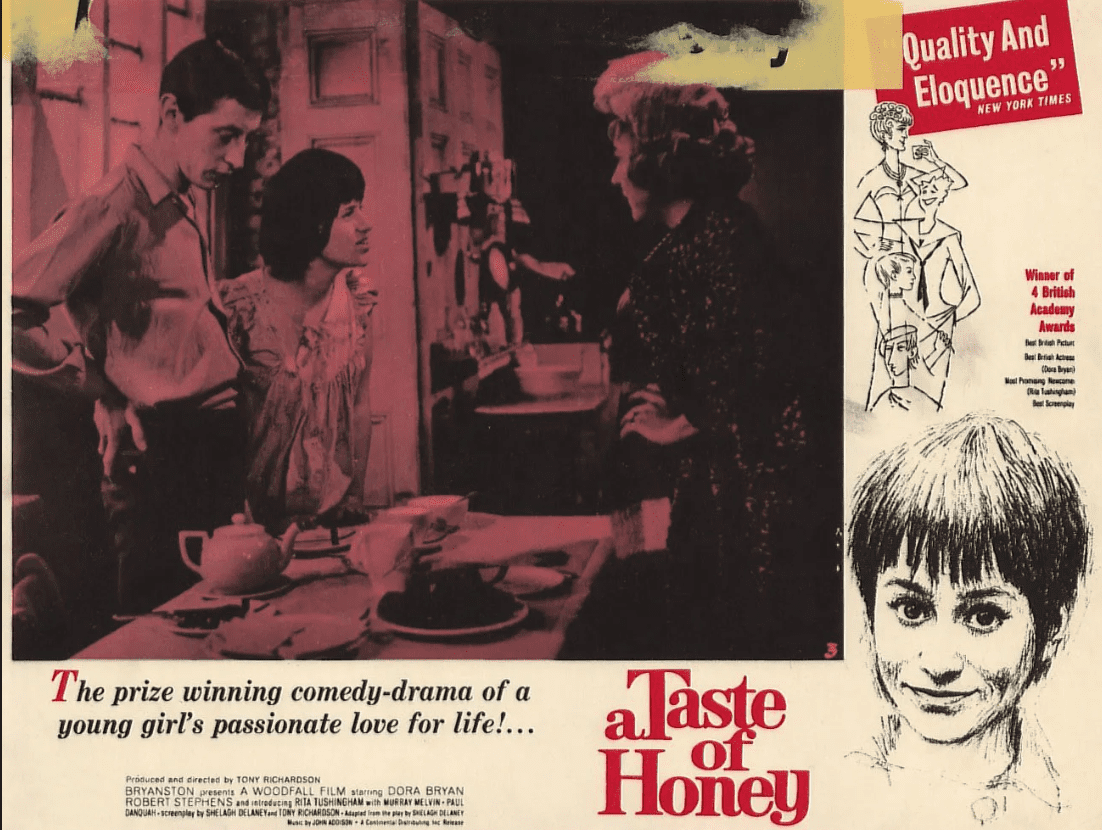
In April 1958, the script was sent to the Theatre Workshop run by Joan Littlewood—arguably the most influential and radical director of the 20th century, known for creating bold and challenging theatrical experiences. The play was accepted and made its debut on 27 May 1959 at the Theatre Royal Stratford East in London, before transferring to the West End. It premiered in New York in October 1960 to great acclaim. A year later, a film adaptation was released. Delaney co-wrote the screenplay with Tony Richardson, and the film scooped four BAFTAs, including Best British Film and Best British Screenplay. It quickly became a classic of British cinema. Overnight, the young playwright’s work became a sensation, shining a spotlight on working-class life, teenage pregnancy, race relations, and the sheer loneliness of a sprawling industrial city.
Major Creative Achievements
Although Delaney didn’t write a vast number of plays, her impact on British theatre and cinema was profound. Here are some of her other notable works and projects:
- Dance with a Stranger: Her first historical piece, exploring tragic love, destructive passion, and a despair that ultimately leads to murder.
- The Lion in Love: A comedic play delving into ambition and social dynamics.
- Sweetly Sings the Donkey: A compelling drama written for British radio.
- Charlie Bubbles: The screenplay for a film about a writer returning to his Northern roots in Manchester.
Through her writing, Delaney brought the stories of ordinary people onto the theatrical stage and television screens. She continued her career as a screenwriter, crafting significant works for both film and TV.
A Theatrical Revolution and Lasting Legacy
Delaney’s works were more than just plays; they fundamentally shifted public attitudes and challenged the social standards of the day. Here are the key elements that made her writing truly revolutionary:
- Depicting mixed-race relationships: For instance, a romance between a white girl and a black sailor. Portraying this on stage in the 1950s was an incredibly bold move.
- Tackling homosexuality openly: A full decade before homosexuality was decriminalised in the UK, she featured a caring gay man who becomes the strongest pillar of support for a pregnant teenager.
- Addressing teenage pregnancy and single motherhood: She presented an unflinching look at motherhood and women navigating life without the support of men.
- Using authentic dialogue: Her plays were written in a gritty, lively Northern dialect, rather than polished, standard English.

Delaney’s influence spanned both stage and screen. Initially lumped in with the “Angry Young Men” generation of British playwrights, she always stood apart. The distinctive humour and sharp wit in her plays separated her from many of her contemporaries and cemented her place in the literary world. Shelagh Delaney passed away on 20 November 2011, but her vibrant legacy lives on.
Summary of Shelagh Delaney’s Contributions
| Detail | Description |
|---|---|
| Birth | 1938 |
| Origins | Salford (Greater Manchester) |
| Most Famous Work | A Taste of Honey (1958) |
| Core Themes | Social inequality and working-class life |
| Cultural Contribution | Pioneering social realism in drama |
| Impact | An enduring inspiration for future generations |
Ultimately, Shelagh Delaney’s work was infused with energy, humour, and a drive for cultural change. She kicked open the doors for working-class stories and female voices in British theatre. She proved, once and for all, that the lives of ordinary people are deeply meaningful and inherently dramatic. Because of this, she remains one of the most influential British playwrights of the 20th century.
Sources: